



Balsam Hill is holding its Christmas in July tree sale, and the Hallmark Channel is showing a marathon of movies, including one where a big-city lawyer falls for a small-town tree farmer. Christmas in July is now a real mid-year retail tradition, not just a marketing gimmick.
Brands use this time to encourage early shopping, launch holiday promotions, and get people thinking about December well ahead of time.
But for many shoppers, Christmas isn’t something they’re planning for yet… It’s something they’re still paying off.
We asked people in the UK and US how they feel about their Christmas finances halfway through the year. The results show that while retailers have moved on, many shoppers have not.
Christmas debt doesn’t disappear with the decorations
Most people like to think Christmas ends when the decorations come down. Financially, that’s often not the case.
Our research found:
- 36% of Brits say they’ve never gone into debt for Christmas.
- 26% of Brits say they’re still carrying a significant amount of Christmas debt.
- 44% of Americans have borrowed, used credit, or dipped into savings more than once for Christmas.
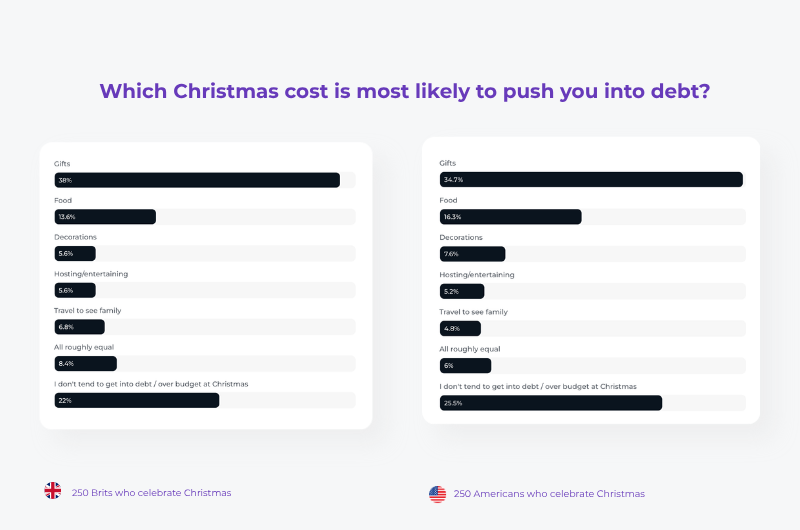
- 38% of Americans say gifts are the biggest reason they overspend.
- 30% of Americans admit they haven’t told their partner or family the full cost of Christmas.
- 20% of Americans say some of this year’s Christmas savings are quietly paying off last year’s bills.
That final figure tells a story all on its own. One in five Americans isn’t just saving for Christmas 2026. They’re paying for two Christmases at the same time.
Last year’s debt didn’t stay behind with the wrapping paper. It packed a suitcase and came along for summer.
How long does Christmas debt last?
Not everyone who spends more at Christmas goes into debt. But for those who do, paying it off can take months.
UK
- * 42% say they’ve never had Christmas debt.
- 20% took two to three months to clear it.
- 16% paid it off within one month.
- 10% cleared it immediately.
- 4% are still paying it off in July
US
- 26% say they’ve never had Christmas debt.
- 17% took two to three months to clear it.
- 21% paid it off within one month.
- 21% cleared it immediately.
- 9% are still paying it off in July
Americans seem more likely to clear Christmas debt quickly, but they’re also more likely to still be carrying it months later. The UK experiences less long-term Christmas debt overall, yet those who do fall behind often spend longer catching up.
Christmas debt in the UK vs US
If you combine the data from both countries, you miss the details. Looking at them separately shows two very different patterns.
Who still feels last Christmas?
- UK: 29% say they’re usually still feeling the financial effects by the time the next Christmas arrives.
- US: 48% agree.
Who borrows for Christmas?
- 43% of Brits have never borrowed, used credit, or dipped into savings
- Only 33% of Americans can say the same
- 44% of Americans have borrowed more than once for Christmas, compared with 25% of Brits
Who’s already budgeting for Christmas 2026?
Despite carrying more Christmas debt, Americans are planning ahead sooner.
- 21% of Brits have already started budgeting.
- 40% of Americans have.
Having debt doesn’t always stop people from getting ready for the next holiday season. Often, they do both at once.
Who is changing their Christmas spending?
Almost half of Brits (49%) admit they haven’t really thought about changing how they’ll approach Christmas this year.
In the US, that falls to 31%.
Instead, Americans are more likely to:
- Save a fixed amount every month (25%)
- Stick to a strict Christmas budget (25%)
The US appears to have a heavier debt cycle, but also more active financial planning.
Who expects to spend more this Christmas?
British consumers appear relatively settled.
- 61% expect to spend about the same as last year.
- Only 9% expect to spend more.
Americans are much less certain.
- 24% expect to spend less.
- 23% expect to spend more.
That suggests many households are still deciding what Christmas 2026 will actually look like.
.
What causes Christmas debt?
Christmas dinner empties the fridge.
Christmas gifts empty the bank account.
For retailers, that’s an important distinction. Consumers aren’t necessarily worried about the cost of celebrating. They’re worried about the cost of buying for everyone else.
What do consumers think would actually help?
Ask people what would improve their Christmas finances and the answer isn’t “save earlier.” Instead, the most common response is simple.
Earn more money.
- 35% of Brits chose higher income.
- 43% of Americans agreed.
Other responses included:
- Spending less on gifts
- Feeling financially comfortable already
- Making small changes to Christmas spending
Only around one in ten people in either country believed starting their Christmas savings earlier would solve the problem. For most households, Christmas debt isn’t a planning issue. It’s an affordability issue.
What this means for retailers and marketers
Christmas in July campaigns often assume shoppers have emotionally and financially moved on from December.
Our research suggests many haven’t.
There isn’t one type of Christmas shopper in July. There are shoppers who’ve never had Christmas debt. Shoppers who only finished paying it off a few weeks ago. Shoppers already saving for next year. And shoppers quietly hoping this year’s Christmas won’t cost quite as much as the last one.
Understanding which audience you’re talking to matters.
Because a promotion built around excitement will land very differently with someone who’s still looking at last Christmas on their credit card statement.
Ask your questions.
We gathered these insights and analysed them from 1,000 consumers in less than 30 minutes.
If you’d like to test an idea, validate a campaign, or understand what your audience is thinking today, not next month, create your first OnePulse survey for free using your work email.