

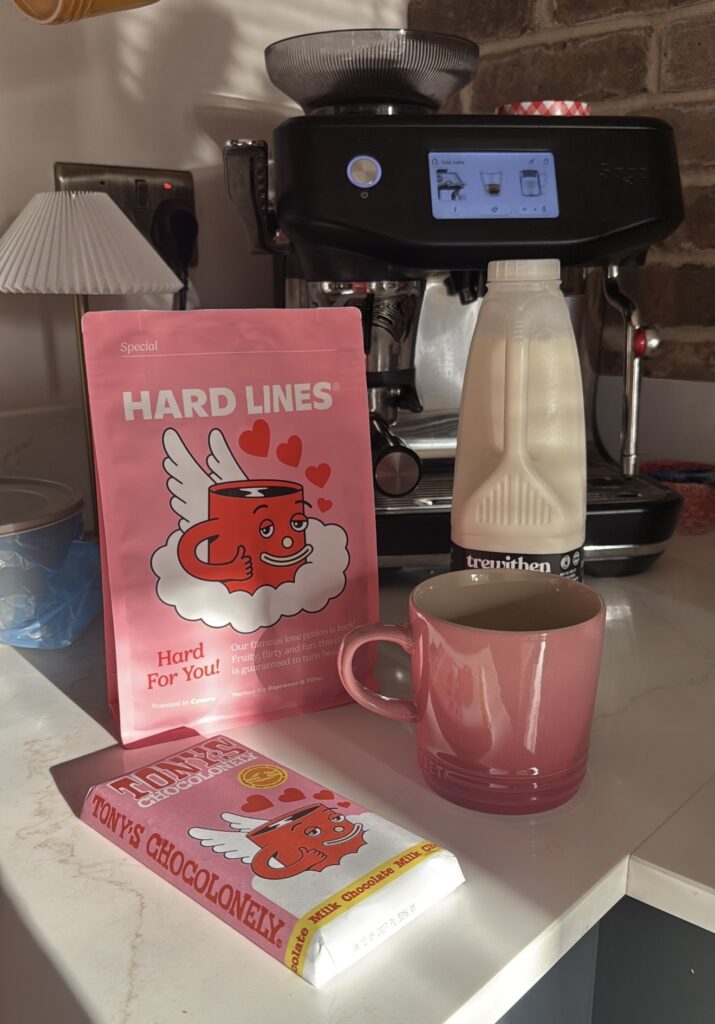
But it wasn’t just about the pairing. Because yes, we all know coffee and chocolate are an elite combination. Hard Lines donates through 1% for the Planet, and Tony’s is on a mission to make chocolate 100% slave-free. So the freebie didn’t feel random or throwaway. It felt considered.
Valentine’s Day used to mean last-minute flowers and awkward cards. But lately, it’s starting to feel like a moment where brands try to show they stand for something, not just sell you another heart-shaped product.
And that landed for us recently. Our marketing manager ordered her usual Hard Lines Coffee beans. She knew a limited number of the first orders of their much loved valentine’s beans would include a freebie of Hard Line’s branded Tony’s Chocolonely. Still, when it arrived, it felt like a nice little moment. A quick photo in Slack. Someone noticed the packaging perfectly matched the pink mug. And the chocolate didn’t last long.
Match made in pink heaven…
Which got us thinking. When brands partner up or include freebies from other brands, how do consumers actually perceive it? Does it build trust, or does it fade as soon as the treat’s gone?
We asked the OnePulse community. Here’s what they told us.
Do consumers support brands because of their values?
60% of consumers have supported a brand because of its values.
That includes 19% who’ve done it loads of times, and 41% who’ve done it once or twice. The key thing here isn’t that everyone does this. It’s that most people have. Brand values aren’t the main reason someone buys, but they’re often the deciding factor between two similar choices.
On the flip side, 25% said not really, and 13% said they’ve never thought about it. Which is why subtlety matters. Purpose works best when it’s part of the brand story, not the headline.
Does timing, like Valentine’s Day, affect how brand partnerships are perceived?
65% of people say Valentine’s is a good time for brands to show their values.
That breaks down into:
-
17% saying definitely
-
48% saying maybe, if it feels genuine
But there’s a clear warning sign too. 21% see Valentine’s as just another shopping holiday, and 14% say value-led campaigns can feel forced at this time of year.
What makes a brand’s freebie or partnership feel genuine to consumers?
32% say transparency about where the money goes is the biggest marker of a genuine partnership.
That’s followed by:
-
Long-term support of a cause
-
Not making it all about profit
-
The brands genuinely make sense together
-
Honest storytelling
Storytelling ranked lowest. Which is telling.
People aren’t looking for a clever campaign. They’re looking for proof that a partnership exists for a real reason. That’s why this chocolate with coffee moment worked. The pairing made sense, but the shared values gave it weight.
What risks do brands take when partnering with other brands?
When asked what they’d do if a brand they liked supported a cause they didn’t agree with:
- 38% said they would stop buying
- 28% said they’d wait to see if it was a one-off
- 17% said they’d give feedback
- 17% said they’d keep buying regardless
That means over half of consumers would actively reconsider their relationship with the brand.
Do brand freebies actually build consumer connection?
Sometimes. But only when they’re done right. When asked whether a small freebie tied to a good cause makes them feel more connected to a brand:
- 50% said sometimes, depending on how it’s done
- 18% said yes, it shows the brand has thought it through
- 32% said no, it feels like marketing fluff
The freebie itself isn’t the magic ingredient. The intent behind it is. Consumers are quick to tell the difference.
Do consumers notice the ‘why’ behind brand freebies?
More than brands might expect.
- 18% said they always read the reasoning behind brand partnerships or research the freebie brand
- 44% said they sometimes do, if it catches their eye
- 25% said they rarely do
- 14% said they never do
Most consumers are at least open to understanding why they received a freebie. Brands just need to make the story clear, simple, and honest.
The red flags people spot straight away
When partnerships or freebies miss the mark, the same issues come up again and again:
- One-off PR stunts
- All hype, no substance
- No transparency about impact
- Values that don’t align
Interestingly, over-explaining ranked lowest. People don’t want a big sell. They want to see that a partnership makes sense without being told to believe it.
So, what’s the takeaway?
Let’s be very real here. A free bar of chocolate with a coffee order isn’t revolutionary. But what made this one land was that it felt aligned, intentional, and true to the brands involved.
The data backs that up. Consumers do notice brand partnerships and branded freebies. But they judge them quickly. What matters isn’t the size of the gesture. It’s whether it feels genuine.
Get it right, and even something small can build trust. Get it wrong, and people clock it just as fast.
Thinking about a brand partnership or throwing in a freebie?
Before you commit, find out how consumers will actually react.
Book a demo and let us show you how real-time insights can help you test ideas, spot red flags, and make confident decisions, before anything goes live.