


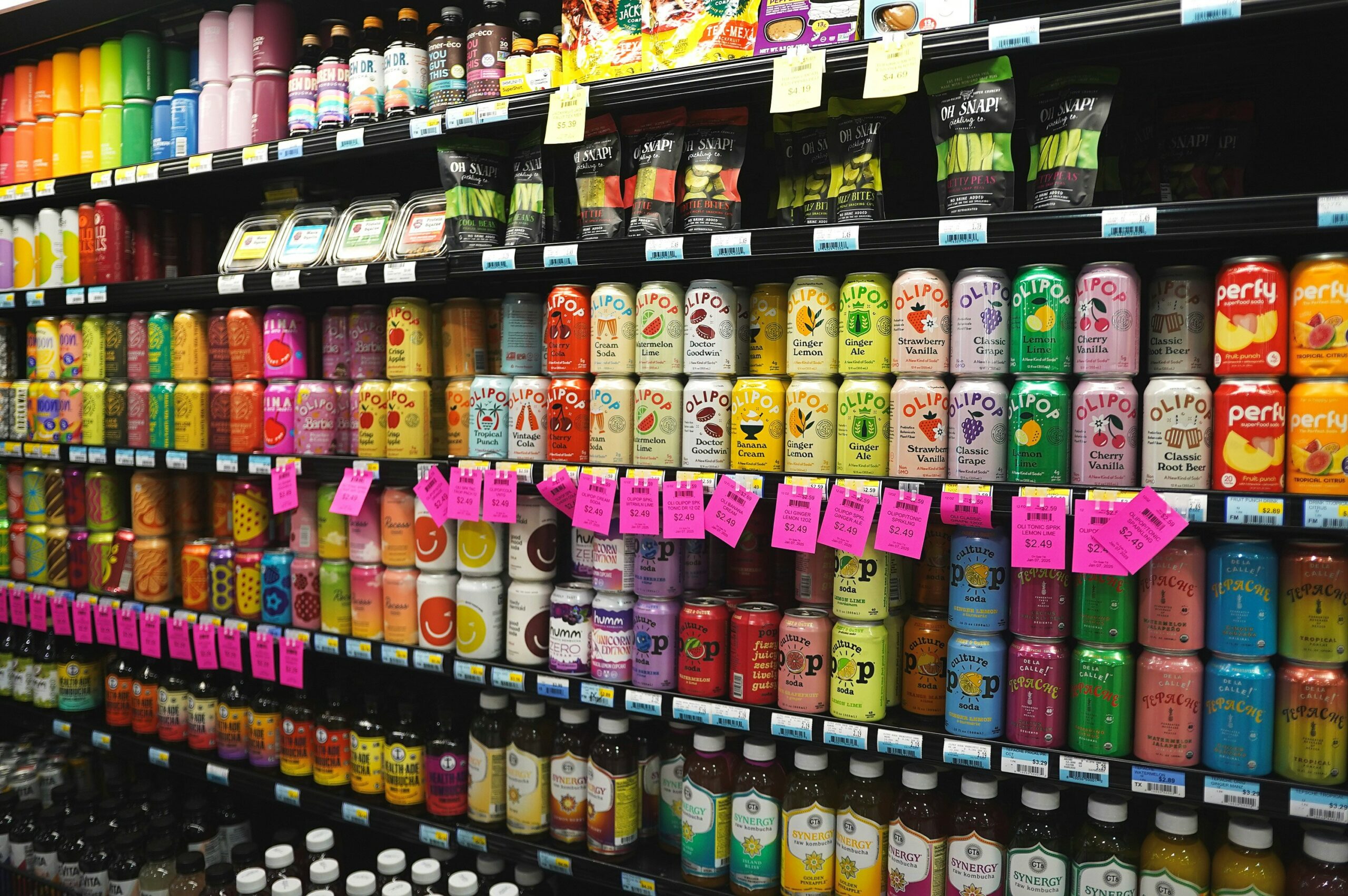
Functional food and drink are growing fast around the world. Protein snacks, probiotic drinks, vitamin-fortified cereals, collagen supplements, and electrolyte waters are everywhere. But do consumers actually trust these products? That’s a question brands don’t often ask.
In May 2026, we surveyed adults in the UK and in the US. We wanted to know how they feel about functional foods, which added benefits they trust most, and what they would actually pay extra for. The answers may surprise you.
What are functional foods and drinks?
Functional foods are regular products with added ingredients intended to provide health benefits beyond basic nutrition. Examples include protein bars, probiotic yoghurts, vitamin-enriched snacks, collagen drinks, and electrolyte waters.
The market is large and growing quickly. In early 2026, we saw sparkling protein drinks from Beyond The Plant Protein Co, prebiotic sodas like Poppi and Olipop entering the UK, mushroom-extract drinks from Blynk Drinks, and PepsiCo launching Doritos Protein, a high-protein crisp made with dairy-based casein.
Functional foods are now mainstream, not niche. But just because these products are widely available doesn’t mean people fully trust them. Our data show that trust remains lacking.
How do consumers feel about functional foods in 2026?
When we asked UK consumers for their first reaction to foods and drinks with added benefits, only 14% said they see them as “genuinely useful innovation.” In the US, that number is a bit higher at 22%, but it’s still a small share.
Most people in both countries think these products “can be useful, but many feel over-marketed.” That’s 45% in the UK and 39% in the US. Another 33% in the UK say these products “mostly feel like processed products given a healthy spin.” In the US, it’s 27%.
When we asked for their overall opinion, 46% of UK consumers said functional products are “overpriced for what they really add.” Only 16% think they offer real benefits. In the US, 23% have a positive view, but that’s still a minority.
“It would be much better to buy the right food instead of buying rubbish with additives. If you want iron, eat spinach.” – OnePulse respondent, UK, May 2026
That idea, to eat real food instead, came up often in our open responses. It shows that for many consumers, this whole category seems like a solution to a problem that doesn’t really exist.
But it’s not the only view. Others are more pragmatic:
“In this busy world, I’m grateful for any extra nutrients in my food and drinks.” – OnePulse respondent, UK, May 2026
Consider this alongside what’s launching now. Starbucks is introducing protein cold foams and protein lattes in regular coffee shops. PepsiCo has added protein to Doritos. These are not small wellness brands; they are some of the biggest names in food. Still, most consumers remain cautious about the category.
Are UK and US consumers different when it comes to functional food?
Yes, and the difference is significant. The gap between the two markets appears throughout the data.
UK consumers are harder to convince. They are more likely to see added benefits as marketing spin, less likely to believe the products are truly worthwhile, and, as we’ll discuss, much less willing to pay extra.
US consumers are more open to these products. They are more likely to call functional foods real innovation and more likely to say added benefits make processed products feel more acceptable (18% in the US, compared to 9% in the UK, said “yes, much more acceptable”).
Part of this difference is cultural. The US has a longer history with sports nutrition and wellness products. Brands like Olipop and Poppi built credibility for prebiotic soda in the US before entering the UK market. Poppi only officially launched in the UK in early 2026. The trust infrastructure for these categories is not yet established in the UK.
But even in the US, scepticism is still common. Being more open does not mean consumers are convinced.
Which functional food benefits do consumers trust most?
Not all added benefits land the same way. Here’s how trust breaks down across both markets:
UK
Protein – 23%
Vitamins or minerals – 22%
Fibre – 18%
US
Protein – 24%
Vitamins or minerals – 22%
Electrolytes – 18%
Protein and vitamins/minerals are the clear winners, with strong agreement across both markets. It’s not a coincidence; these benefits have the longest history and the most consumer education.
Beyond Immerse, the new sparkling protein drink from Beyond The Plant Protein Co, is a good example of a brand using this approach. It combines protein, fibre, electrolytes, and vitamin C in one product. Instead of asking consumers to trust one unfamiliar ingredient, it brings together benefits that already have credibility.
Fibre vs electrolytes: a tale of two markets
UK consumers trust fibre more than twice as much as US consumers (18% vs 8%), likely thanks to decades of NHS public health messaging. On the other hand, US consumers trust electrolytes almost twice as much as UK consumers (19% vs 10%), which reflects America’s strong sports nutrition culture.
Though it’s worth noting, not everyone is impressed by electrolyte drinks either:
“Electrolytes are usually just salt. A lot of these things you can either make yourself at home using simple kitchen ingredients or incorporate more into your diet using whole foods.” – OnePulse respondent, UK, May 2026
For brands expanding into new markets, the trust gap between the UK and the US is important. A benefit that works in one country may not work in the other. Blynk Drinks, which is bringing Lion’s Mane, Reishi, and Cordyceps mushroom extracts to the UK, is entering a market where unfamiliar ingredients face an even bigger trust challenge than in the US.
Why do consumers trust or distrust a functional benefit?
We asked consumers to explain their trust decisions. The top reason they trust their most trusted benefit? “It seems more natural than other added benefits”, 22% in the UK and 21% in the US. “Backed by science” came fourth in the UK (15%) and even lower in the US (11%).
Companies spend a lot on clinical evidence and scientific formulation, but consumers decide what to trust based on whether something feels real and familiar, not on clinical trials. Some consumers go even further than that:
“Most added vitamins are synthetic L orientation instead of D orientation. Since biological organisms use D-oriented molecules, bodies convert L molecules to D orientation, resulting in the release of free radicals.” – OnePulse respondent, UK, May 2026
This level of ingredient knowledge, even if not common to everyone, shows that some consumers are genuinely informed and harder to convince than brands might expect. Others just prefer to keep things simple:
“It doesn’t look honest. I’d rather take a vitamin than a food with added things in it.” – OnePulse respondent, UK, May 2026
What makes consumers distrust a functional claim?
The top reason for distrust is the same in both markets: “it feels like a marketing gimmick” (UK: 38%; US: 37%). Second is “not sure it really works” (UK: 28%; US: 30%). Our open responses put flesh on those numbers:
“I look at how much is in it. ‘HIGH PROTEIN’ plastered across the product, but then you look at the nutritional info, and there’s barely any in there at all.” – OnePulse respondent, UK, May 2026
US consumers are also more concerned about processing, 23% say a benefit “seems too processed or artificial”, compared to 17% in the UK. This reflects the growing cultural conversation around ultra-processed foods in the US, and it’s something brands entering that market can’t ignore.
The takeaway is to focus on naturalness, simplicity, and familiarity, not just science. Use ingredients people recognise, make claims they can check, and keep packaging straightforward.
What do consumers do when they see a functional claim on packaging?
We asked consumers what goes through their minds when they spot an added benefit on a product. The most common response in both markets: “it depends on the benefit being claimed” (UK: 34%; US: 35%).
Consumers aren’t switching their brains off. They’re making call-by-call decisions based on the specific ingredient. A solid brand reputation in one benefit area doesn’t automatically carry over to another.
Fruit Riot’s launch in Tesco in the UK is a good example of a brand doing this well. By focusing on fruit, which is easy to understand and trust, they are not asking consumers to take a leap of faith. The benefit is clear. This gives them an advantage over brands that use unfamiliar extracts.
It’s worth noting that only 16% in the UK and 15% in the US say a benefit claim makes a product “seem healthier.” Also, 17% of UK consumers say it makes them more sceptical. A benefit claim is not always positive; for some shoppers, it’s a warning sign.
Are consumers willing to pay more for functional food benefits?
This is where the data becomes most important for business decisions. 1 in 4 UK consumers won’t pay more for functional food benefits.
In the US, that number drops to 17%, which is still significant. In both countries, most people are only willing to pay up to 10% more. That’s the limit for 58% of UK consumers and 55% of US consumers.
The US market allows brands a bit more flexibility with higher prices, but even there, only about 1 in 6 consumers will pay more than 15%. For brands like Olipop and Poppi, which already cost more than regular soft drinks, price sensitivity remains a challenge, especially as they enter the UK market.
Which specific benefits are people most willing to pay for? Protein leads in both markets (UK: 19%; US: 23%), followed by vitamins/minerals (UK: 13%; US: 16%). Collagen makes a surprising appearance at number three in the UK (11%), proof that a loyal niche exists even where general trust is low.
What makes consumers willing to pay a premium for functional food?
We asked consumers directly: what would make a benefit feel worth paying extra for? The answer was clear and uniform across both markets: “I would notice the benefit in real life.” That’s 37% in the UK and 42% in the US.
It’s not about scientific credentials or brand reputation. What matters is a personal, noticeable impact. The barriers to paying more tell the same story from the other side:
* Doesn’t feel genuinely beneficial (UK 32%, US 31%)
* Don’t trust the claim or ingredient (UK 31%, US 29%)
* Wouldn’t notice the benefit in real life (UK 29%, US 31%)
* Doesn’t feel worth the extra cost (UK 27%, US 31%)
Trust and noticeable impact are the two key factors. If you get both right, the higher price makes sense. If you miss either one, people won’t pay extra.
Key takeaways for food and drink marketers
The functional food category is not struggling with its concept; consumers understand what these products aim to do. The real issue is credibility. Most people don’t believe these products deliver on their promises.
- Protein and vitamins or minerals are the safest foundation. They are the most trusted benefits in both markets and the ones consumers are most willing to pay for. If you are adding multiple benefits, start with these.
- The UK and US are different markets. Fibre is more popular in the UK, while electrolytes are more popular in the US. What works in one country may not work in the other.
- At the point of sale, naturalness is more important than science. Familiar ingredients and simple claims work better than clinical language. Fruit Riot’s focus on fruit gives it an advantage over brands that use unfamiliar ingredients.
- Pricing in the UK should be approached with caution. 1 in 4 UK consumers will not pay extra. The limit for price increases is low.
- New ingredients need more time to gain trust. Ashwagandha, lion’s mane, and nootropics are interesting, but most consumers still do not trust them. Brands like Chill Spritz, Blynk, and Neutonic need to educate consumers before they can charge higher prices.
- If it’s true, don’t just claim it. Convenience and felt impact are what unlock spend. “You’ll feel the difference” is the most powerful thing you can say, but only if it’s true.
Find out what your customers really think.
All of this data came from real consumers answering real questions in just minutes. Whether you are launching a new product, testing a claim, or trying to understand how shoppers see your category, we can help you get answers quickly.
Send your first survey for free, or book a demo for an extended trial, and we’ll set you up for a no-strings-attached trial.
____
Data from OnePulse was collected in May 2026. All figures rounded to the nearest whole number. Consumer quotes are verbatim responses from the free-text question: “When does adding a health benefit to a food or drink feel genuinely worthwhile rather than just a sales tactic?”