


If you’d never heard of the Lion’s Gate Portal before clicking on this, you’re in good company. 52% of Americans and nearly 3 in 4 Brits hadn’t either, until OnePulse asked them about it directly.
The Lion’s Gate Portal is a modern spiritual tradition inspired by Sirius, the brightest star in the night sky. Ancient Egyptians closely tracked Sirius’s annual return to the dawn sky, but the Lion’s Gate Portal itself is a modern New Age idea. Today, many astrologers see August 8 (8/8) as a symbolic time for manifestation and letting go of whatever no longer serves you. Whether any of that actually does anything is, obviously, a matter of opinion.
So we surveyed 1,500 people in the US and UK about astrology in general, then sprang the Lion’s Gate Portal on them specifically to see what happens once belief stops being abstract and becomes an actual, specific date on the calendar. Turns out most people who’d never heard of it still had an immediate, honest answer once we explained what it was for, which says more about people than it does about the stars.
The numbers, side by side:
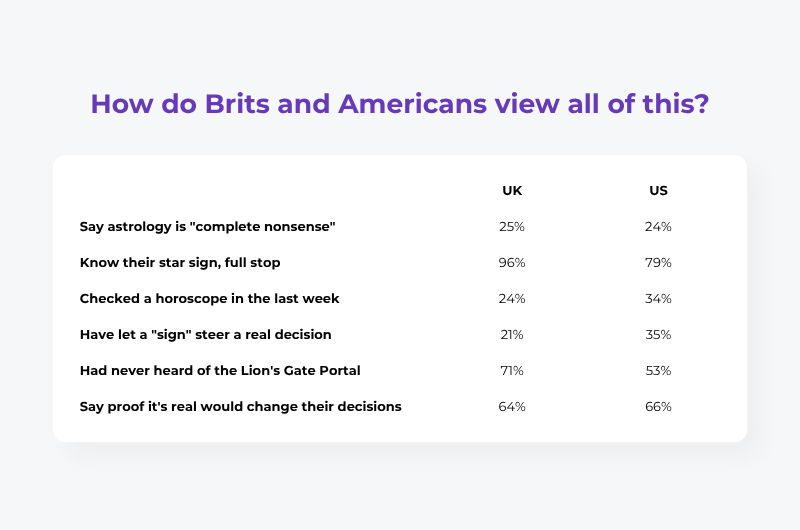
Americans are more likely to believe it, act on it, and already know about the Lion’s Gate Portal. Brits are more likely to know their star sign cold while insisting, unconvincingly, that none of it means anything. Keep both of those in mind as we go.
The “I don’t believe in this” crowd knows a suspicious amount about this
Ask someone if they believe in astrology, and about 1 in 4 will tell you, flatly, that it’s nonsense – 25% in the UK, 24% in the US. 12% of Brits and 19% of Americans say they fully believe; another 31% in both countries call themselves genuinely unsure; and 32% of Brits versus 27% of Americans say they don’t believe it but engage anyway.
Then ask the same group their star sign.
Nearly all of them know it: 57% of Brits know their sign and what it means, with another 39% knowing just the sign; in the US, it’s 46% who know the meaning and 33% who know just the sign, with 20% drawing a blank entirely. That’s 96% of Brits and 79% of Americans who can name their sign, including plenty of people who’d just told us the whole thing was made up.
And a lot of people are still reading horoscopes on purpose.
34% of Americans and 24% of Brits checked one in just the past seven days. Add in the people who don’t “believe” but engage anyway- 27% of Americans, 32% of Brits- and you’ve got a majority in both countries who are doing something with astrology even while denying it means anything.
Some people are letting the stars make real decisions
This is where “harmless fun” starts to wobble a bit. 21% of Brits and 35% of Americans have let a horoscope or “sign” actually influence something that matters, such as ending a relationship, quitting a job, or making a big purchase. Split it further, and it gets more specific: in the UK, 9% say it worked out, and 11% say it didn’t; in the US, 21% say it worked out against 14% who say it didn’t.
A quarter of Brits and nearly 4 in 10 Americans have done something like this and never told a single person, or only told one or two. Broken down: 10% of Brits are keeping it fully buried, and 15% told just one or two people; in the US it’s 19% fully buried and another 19% who’ve told one or two. One Pulser went further than most, admitting to planning their kids’ star signs around what would “suit the family.”
There’s also a very specific flavour of self-deception hiding in here: people generally only trust the horoscope when it’s flattering. When we asked what actually happens when a horoscope delivers bad news, 24% of Brits and 29% of Americans take it on the chin. 16% of Brits and 15% of Americans decide the app must be broken that day. 12% in both countries admit they only read horoscopes when they’re fishing for good news.
Then we told them about the Lion’s Gate Portal
We already know most people had never heard of the Lion’s Gate Portal going in. Only 9% of Brits actually knew what it was about, against 22% of Americans, so Americans were more than twice as likely to already be in the know, with another 24% of Americans and 20% of Brits somewhere in the middle, having heard the phrase without knowing a single detail about it.
We reminded everyone about the real astronomy underneath it. That single fact nudged people toward taking the whole thing more seriously: 42% of Americans and 31% of Brits said it did. Roughly a third in each country said the astronomy didn’t change anything (35% US, 37% UK), and the rest are still deciding.
Then came the question the tradition is actually built around: is there something you’re ready to let go of? We asked with no prep, no warning. 30% of Americans and 18% of Brits said yes, immediately, they knew exactly what it was. Another 36% of Americans and 40% of Brits felt something but wouldn’t know where to start. Only about a third in each country drew a total blank.
When asked what they’d actually set an intention for, Americans leaned money (27%) and health (26%), with relationships at 18% and career trailing at just 15%. Brits leaned career (21%) and finances (25%), with health at 19%.
And the question that separates real scepticism from stubbornness: if this turned out to be provably, unambiguously real, would it change how you make decisions? 29% of Americans said significantly, and 37% said a little. In the UK, 25% said significantly and 39% a little. Only 10% of Americans and 11% of Brits said they already act like it’s real regardless.
So what’s actually going on
The same people telling us astrology means nothing are checking their horoscope, naming their star sign without hesitation, and quietly letting a “sign” steer real decisions. Most had never heard of the Lion’s Gate Portal, and still knew exactly what they’d let go of the second we asked.
Maybe none of it’s real. But a random date that gives you permission to name what you’re ready to let go of? That part works either way.
People clearly have a lot to say once you ask. Download the OnePulse app and get yours in.
Based on a OnePulse survey of 1,500 adults across the UK and US, conducted August 3-4, 2026. Responses were collected via the OnePulse app.